
Gold or silver? Skin tone is what decides it. The same ring can make one person look glowing and another look washed out, and the difference is almost always the undertone of the skin underneath.
This gold or silver skin tone guide covers the whole question, not just the two metals: how to find your undertone in two minutes, which metals suit cool, warm, neutral, olive, and deep skin, what to do if a metal turns your finger green, and how to wear a metal you love even when the rule says otherwise.
Table of Contents
ToggleThe Gold or Silver Skin Tone Test
Answer three questions in this gold or silver skin tone test, and the tool below tells you your undertone, the metals that suit it, and the stone colours that go with them. The full chart sits under the test.
Gold or silver? Take the skin tone test
Three quick questions about your skin, and you will know which ring metals suit you best. No mirror gymnastics, no guessing.
Question 1 of 3
Look at the veins on your inner wrist in daylight. What colour are they?
In strong sun without sunscreen, what usually happens first?
Hold a white shirt and a cream shirt near your face. Which one looks better?
Your undertone
Cool
Stones that suit you
Good to know
Ring metal and skin tone chart
| Undertone | How to spot it | Best ring metals | Also try | Stone colours |
|---|---|---|---|---|
| Cool | Blue or purple veins, skin burns before it tans, bright white suits you | Silver, white gold, platinum | Rose gold for a softer look | Blue, purple, grey, icy white |
| Warm | Green veins, skin tans easily, cream and ivory suit you | Yellow gold, rose gold, brass tones | Two-tone rings with a gold edge | Green, amber, coral, warm brown |
| Neutral | Veins look blue-green, you burn then tan, white and cream both work | Almost anything, including mixed stacks | Two-tone and tri-colour rings | Most colours, from ruby to emerald |
| Olive | A green or golden cast over any depth of skin | Yellow gold, antique or brushed gold | Rose gold, bronze tones | Emerald, turquoise, warm topaz |
| Deep | Rich brown to very deep skin, any undertone | Yellow gold, high-polish gold | Rose gold, and silver for contrast | Bold colours: ruby, emerald, citrine |
Undertone is a guide, not a rule. If you love a metal, wear it. Contrast can look just as good as a perfect match.
How to Find Your Undertone in 2 Minutes
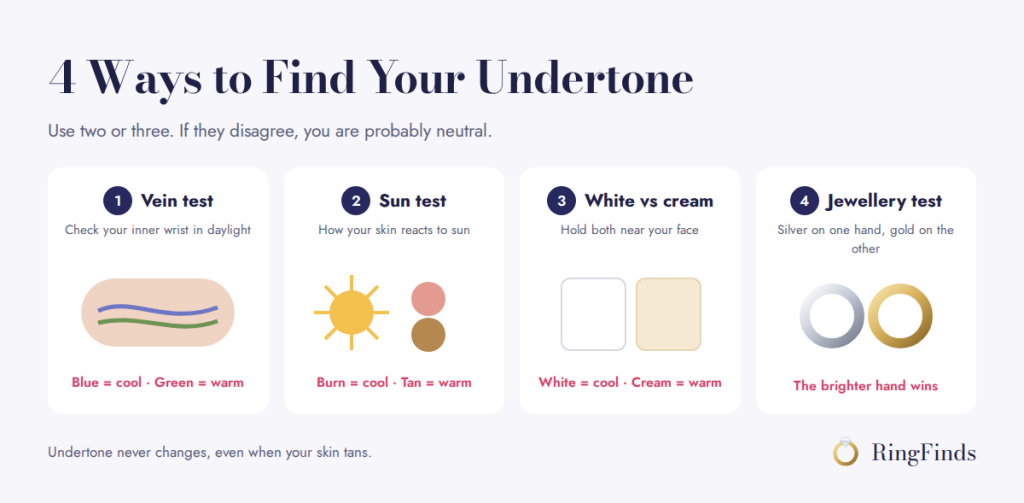
Skin tone and undertone are different. Skin tone is how light or dark your skin is, and it can change with the season. Undertone is the colour sitting underneath, and it stays the same for life. Undertone is what settles the gold or silver skin tone question.
Use two or three of these checks. If they disagree, you are probably neutral.
1. The vein test
Look at the inside of your wrist in daylight, not under a bulb. Blue or purple veins point to cool undertones. Green or olive veins point to warm. If you cannot decide, that is a neutral result.
2. The sun test
Think about your skin without sunscreen. If you burn first and tan slowly, you are usually cool. If you tan easily and rarely burn, you are usually warm. Burning and then tanning is a neutral sign.
3. The white and cream test
Hold a bright white shirt near your face, then a cream one. Bright white flattering you means cool. Cream or ivory looking better means warm. Both looking fine means neutral.
4. The jewellery test
Put a silver ring on one hand and a gold ring on the other, then look at them together in daylight. One hand usually looks brighter and more even. That is your gold or silver skin tone answer, and it beats every other test because it uses the actual metal.
Every Ring Metal, and Who It Suits
Undertone is only half the story. Price, durability, and skin sensitivity matter too, so here is each metal in plain terms.
Yellow gold
Best on warm, olive, and deep skin, where it picks up the golden tones in the skin. Higher karats look deeper and warmer: 22k is rich yellow, 14k is paler and easier to wear on neutral skin. Gold does not tarnish, and 14k is a good balance of colour and hardness for everyday rings.
White gold
Best on cool and neutral skin. It is yellow gold mixed with white metals and finished with rhodium plating, which gives it a bright silver look. That plating wears off over a few years and needs redoing, so budget for it. Some white gold is alloyed with nickel, which matters if your skin reacts.
Silver
Best on cool and neutral skin, and the easiest metal to try because it costs the least. Sterling silver is 92.5% silver with copper making up the rest, which is why it tarnishes and why it can leave a mark on some skin. A quick polish brings it back.
Platinum
Best on cool and neutral skin. It looks close to white gold but is denser, does not need plating, and is naturally hypoallergenic, which makes it the safest choice for sensitive skin. It is also the most expensive of the white metals.
Rose gold
Suits almost everyone, which is why it is so popular. The copper in the alloy gives it warmth, so it flatters warm and olive skin, and its softness also works on fair cool skin where bright yellow gold can look harsh. Deeper skin tones get a lovely contrast from it.
Stainless steel and titanium
Both are cool-toned, hard-wearing, and inexpensive, which makes them good for everyday wear and for anyone who reacts to other metals. Titanium is very light, and neither can be resized easily, so get the size right the first time.
Two-tone and mixed metal
The practical answer for neutral undertones and for anyone who owns both gold and silver pieces. A two-tone ring makes the rest of your jewellery look deliberate rather than mismatched.
Olive and Deep Skin Tones
Most gold or silver skin tone guides stop at cool, warm, and neutral, which leaves out a lot of people. Two extra notes:
Olive skin has a green or golden cast that can read as warm and cool at the same time. Yellow gold and antique or brushed gold finishes usually sit best, because high-shine silver can look grey against olive. Rose gold and bronze tones are a good second choice.
Deep skin tones carry high-shine metals beautifully, and yellow gold in particular has strong contrast against deeper skin. Rose gold gives a softer warmth, and polished silver or white gold creates a sharp, modern contrast rather than a clash. Bold stone colours such as ruby, emerald and citrine also hold their own here, where paler stones can disappear.
Contrast Matters as Much as Colour
Here is the part most gold or silver skin tone advice misses. Alongside undertone, look at the contrast between your skin, hair, and eyes.
- High contrast (dark hair with fair skin, or deep skin with light eyes): polished, high-shine metals and clear stones look striking on you.
- Soft contrast (blonde hair with fair skin, or an even tone throughout): brushed, matte and hammered finishes suit you better, because a mirror polish can overpower.
This is why two people with the same undertone can suit very different rings. If a metal is right but the ring still feels wrong, try the same metal in a different finish before giving up on it.
Metals That Turn Your Finger Green
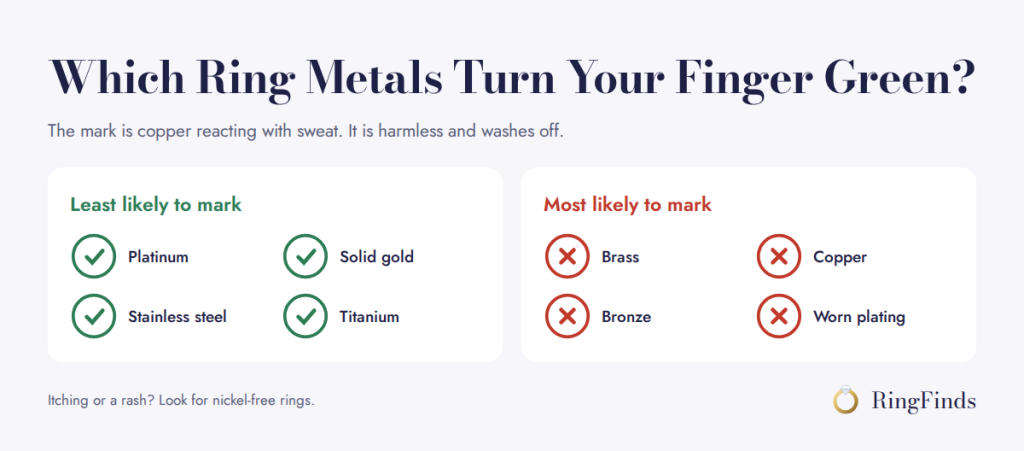
That green mark is copper reacting with the acids in your sweat. It is harmless; it washes off, and it is not proof that a ring is fake. It happens faster in heat, at the gym, and if you keep rings on in the shower.
Most likely to mark your skin: brass, bronze, copper, gold-plated or gold-filled rings once the layer wears off, and sterling silver on some people.
Least likely: platinum, solid gold, stainless steel, titanium, and rhodium-plated white gold.
If your skin reacts rather than just marks, nickel is usually the culprit. Nickel is one of the most common causes of contact allergy, and it turns up in cheap alloys and in some white gold. Look for rings described as nickel-free, or choose platinum, titanium, or 316L stainless steel. Persistent itching or a rash is worth showing to a doctor rather than treating with a different ring.
How to Mix Metals Without It Looking Wrong
Mixing gold and silver stopped being a mistake a long time ago. It only looks accidental when there is no pattern, so give it one:
- Pick a lead metal. Two rings in one metal, one in the other, rather than an even split.
- Bridge the gap. One two-tone ring in the stack makes everything else look connected.
- Repeat the mix. If your rings mix metals, let your watch or bracelet do the same.
- Keep widths varied. Mixed metals in identical bands can look like a mistake. Mixed widths look styled.
Not sure which sizes to order once you have chosen a metal? Use our ring size chart first, since a wide band in a heavy metal fits tighter than a thin one.
Shopping for Rings in Your Metal
Once the gold or silver skin tone question is settled, the shopping gets simple:
- Everyday wear: 14k gold, platinum, titanium, or 316L stainless steel.
- Sensitive skin: platinum, titanium, niobium, or nickel-free stainless steel.
- Low budget: sterling silver, stainless steel, or gold-filled rather than gold-plated, since the gold layer is thicker.
- Special occasion: solid gold or platinum, which hold their finish for decades.
Browse our ring picks to see options in each metal.
If You Love a Metal That Is Not Your Match
Wear it anyway. The gold or silver skin tone rule is a guide, not a law, and there are three easy ways to make any metal work:
- Change the finish. Brushed or matte gold sits more quietly on cool skin than mirror polish.
- Add a stone. A stone in your flattering colour range draws the eye and balances the metal.
- Move it. A metal that looks off near your face can look perfect on your hand, which is exactly why rings are more forgiving than earrings.
Looking After Each Metal
- Gold: warm water, a drop of mild soap, a soft brush. Dry fully.
- Silver: a polishing cloth after wearing, and store it in a sealed bag to slow tarnish.
- Platinum: the same soap and water routine. Scratches turn into a soft patina rather than damage.
- Rose gold: avoid harsh chemicals, which dull the copper content.
- Plated rings: keep them away from perfume, lotion, and water, and put them on last when you get dressed.
Want to Test Metals Before You Commit?
A cheap set of rings in silver, yellow gold, and rose gold tones is the fastest way to see which one your skin likes, without spending on solid gold to find out.
Gold or Silver Skin Tone FAQ
Is gold or silver better for my skin tone?
The gold or silver skin tone rule is simple: gold suits warm, olive and deep skin tones, and silver suits cool skin tones. Neutral undertones can wear both. Take the test above if you are not sure which group you fall into.
Can I wear gold if I have cool undertones?
Yes. Choose a lower karat such as 14k, which is paler, or a brushed finish instead of high polish. Rose gold is also a softer way into warm metals.
What metal suits olive skin?
Yellow gold, especially in antique or brushed finishes. Bright silver can look grey against olive skin, while rose gold and bronze tones work well.
What metal suits deep skin tones?
Yellow gold gives the strongest contrast and looks rich against deeper skin. Rose gold is softer, and polished white metals give a clean, modern contrast.
Which ring metals do not turn your finger green?
Platinum, solid gold, stainless steel, titanium and rhodium-plated white gold are the safest. Brass, bronze, copper and worn plating are the most likely to leave a mark.
Which metal is best for sensitive skin?
Platinum, titanium, niobium and nickel-free stainless steel. Nickel is the usual cause of a reaction, so check the description before buying.
Can I mix gold and silver rings?
Yes. Pick one metal to lead, add a two-tone ring to bridge the two, and vary the band widths so the mix looks deliberate.
Does my undertone ever change?
No. Your skin gets lighter and deeper with the seasons, but the undertone underneath stays the same, which is why your metal choice holds all year.
Found your metal? Check your size with our free ring size chart before you order, and you will only need to do this once.
Bookmark this gold or silver skin tone guide, and come back to the test whenever you are choosing a new ring, a gift or a wedding band.
This post contains affiliate links. As an Amazon Associate, I earn from qualifying purchases.
Pingback: 15 Fall & Thanksgiving Rings for Women - RingFinds
Pingback: Rings That Don't Turn Your Finger Green: 7 Safe Picks